
Truth or Consequences for Todd Blanche and the DOJ
The DOJ high command is boxed in by the record in the Abrego Garcia case

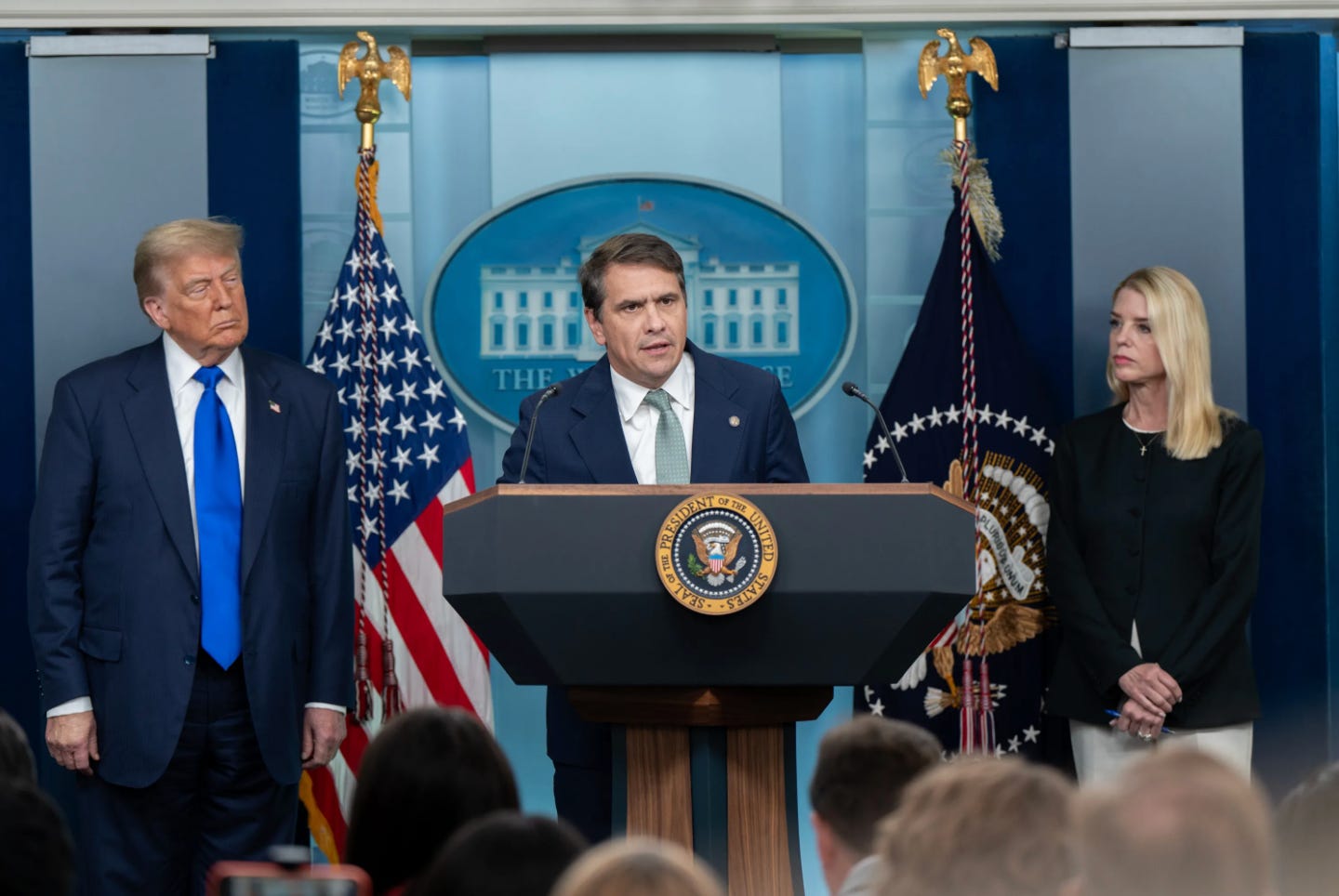
A newly unsealed memorandum opinion by U.S. District Judge Waverly Crenshaw dramatically reframes the criminal case against Kilmar Abrego Garcia—and places the Justice Department, and Deputy Attorney General Todd Blanche, in a bind of their own making.
Originally written on December 3rd and unsealed Tuesday, the opinion reveals internal DOJ communications that call into question the government’s insistence that Abrego’s prosecution was routine and locally decided, and it leaves Blanche and Attorney General Pam Bondi facing an unappealing choice: defend the case under testimony from top-level officials, or abandon it and absorb the institutional and reputational fallout.
After reviewing more than 3,000 internal government documents, Judge Crenshaw concluded that the decision to prosecute Abrego Garcia, after Abrego Garcia successfully challenged his wrongful deportation, may have been driven by improper retaliation rather than by-the-book law enforcement. The ruling orders disclosure of senior-level DOJ communications and sets an evidentiary hearing for January 28th that could result in dismissal of the charges altogether.
The documents Judge Crenshaw ordered sketch a very different story from the one the Department has been propounding.
In November 2022, Abrego Garcia was stopped by Tennessee Highway Patrol and released without a ticket. The matter was referred to Homeland Security Investigations, which opened a human-smuggling inquiry the following month—and then let it go dormant. No charges were brought. For more than two years, nothing happened.
In March 2025, the Trump administration removed Abrego Garcia from the United States to El Salvador—an action the government later conceded was the result of an “administrative error,” and one taken despite a 2019 immigration judge’s order barring his removal to that country. At the time, members of the administration publicly insisted Abrego Garcia would “never touch American soil again,” even as they fought in court over his return. Abrego Garcia sued in federal court in Maryland. He won. The district court ordered the government to “facilitate” his return. The Fourth Circuit affirmed. The Supreme Court affirmed.
Forced to reverse ground, the administration brought Abrego back—only to reveal that they had rushed to secure a sealed indictment in Tennessee based on the long-dormant 2022 traffic stop. His court-ordered return was converted into the occasion for announcing criminal charges, unveiled publicly and with evident fanfare at the moment of compliance.
On June 6, 2025, Attorney General Pam Bondi personally announced the indictment, stating that Abrego Garcia would face trial on alien-smuggling charges and, if convicted, serve prison time before deportation. In announcing the charges, Bondi presented the prosecution as a routine criminal case arising out of Tennessee, without acknowledging any role for senior officials at Main Justice. That’s the position that the DOJ continues to take in court.
That account would have amounted to a complete departure from the Administration’s treatment of Abrego Garcia to that point, which had been marked by successive efforts to disparage him and otherwise resist owning up to their mistake, all driven from the very top.
The case was far from routine in other respects. The government’s case against Abrego Garcia was built by inducing cooperation from the alleged mastermind of the smuggling operation in order to prosecute Abrego himself—an approach that runs counter to the Justice Department’s ordinary practice of building cases upward rather than down.
Blanche, for his part, appeared on Fox News and described the department’s prosecution as a response to a Maryland judge’s criticism of the government’s deportation of Abrego Garcia, saying DOJ acted out of an obligation to investigate once the judge questioned the prior removal.
In the unsealed memorandum opinion, Judge Crenshaw cited Blanche’s remarks as part of the record suggesting a “realistic likelihood” of vindictive prosecution.
But the evidence of vindictive prosecution is more robust and direct. The unsealed memorandum chronicles several documents that support Abrego Garcia’s legal position that the prosecution is vindictive, and that presumably will be front and center at the hearing.
On April 27, Aakash Singh—an aide to Deputy Attorney General Todd Blanche—contacted multiple DOJ officials regarding Abrego Garcia, including then-Acting U.S. Attorney for the Middle District of Tennessee Rob McGuire. That same day, McGuire received Abrego Garcia’s file from Homeland Security.
Three days later, Singh, who appears to be a central actor in the prosecution decision, described the case as a “top priority.”
As charging decisions approached, McGuire sought further involvement from Main Justice. On May 15, he wrote that while the ultimate decision would “land” on him, he hoped to have “ODAG eyes” on the matter. He added that he had not received formal direction from the Office of the Deputy Attorney General, but had “heard anecdotally that the DAG and PDAG would like Garcia charged sooner rather than later.”
A grand jury indicted Abrego six days later, on May 21.
Judge Crenshaw drew the obvious inference. The documents, he wrote, “suggest not only that McGuire was not a solitary decision-maker,” but that “the decision to prosecute Abrego may have been a joint decision,” one that “may contradict” the government’s prior representations that the case was handled locally and without outside influence.
To my ear, McGuire’s inclusion of the phrase that the decision would “land” on him is a sanitized detail to suggest, as DOJ would want to portray, business as usual. More importantly, as a former U.S. Attorney, I can attest that when a case is a top priority for the DAG, who wants the case charged sooner rather than later, the charging decision is the U.S. Attorney’s in a formal sense only.
In any event, that is part of what the evidentiary hearing on January 28 is designed to reveal. Did the order come from the top, like the rest of the immiseration of Abrego, or was it a routine local decision?
It’s noteworthy in the overall context of the Administration’s propaganda efforts that the Department, as it has done so many times, attempted to block disclosure of these communications by invoking work-product, attorney-client, and deliberative-process privileges. Judge Crenshaw rejected those claims—not categorically, but as applied here.
“The Court recognizes the government’s assertion of privileges,” he wrote, “but Abrego’s due process right to a non-vindictive prosecution outweighs the blanket evidentiary privileges asserted by the government.”
The reasoning is straightforward. Vindictive-prosecution doctrine exists precisely because motive matters—and because that motive is often visible only inside the government’s own files. If the case is brought for a vindictive motive, it is a violation of the due process clause, plain and simple, without regard to the strength of the evidence. And if privilege automatically barred discovery in such cases, the doctrine would be meaningless.
The Justice Department now faces a narrowing set of imperfect choices. To proceed, it must rebut the inference of vindictiveness with objective evidence. Abrego Garcia’s lawyers will want to call Blanche and portray him as the ultimate decisionmaker. The Department will resist, but it is hard to see how it can evade testimony from at least Singh in light of his red-handed email. And the testimony is unlikely to go well: Singh or whoever testifies will be tied in knots if they try to insist, notwithstanding the clear documentary record, that this was a routine Nashville decision.
Moreover, after a bruising evidentiary hearing, they are likely to lose. Judge Crenshaw already has found the basis for a presumption, and it’s evident that he regards the Department’s every word with extreme skepticism.
And they resist providing the most authoritative testimony at their own acute risk of having the case dismissed, given that Judge Crenshaw already has found a presumption of vindictiveness that they will have to rebut. Such a dismissal in a high-profile case—when they already are fighting on the same ground in several other cases—can only reinforce the growing narrative that rank politics, not law, drive the Administration’s decisions in high-profile cases.
Of course, there is another reason that Judge Crenshaw is likely to find against them and dismiss the case even if they testify. That’s because the Department’s account is no longer plausible. It’s untenable after all that has happened in the Abrego Garcia case to try to maintain the Department’s highest officials left the process and decision to the workaday process in the Middle District of Tennessee.
Testify, get clobbered on the stand, and lose the case anyway—not a very palatable course of action. What the Department might choose instead is to simply dismiss the charge against Abrego Garcia themselves, which would moot the whole controversy about the vindictive prosecution. It would, in fact, be oh-so-Trumpian—rattle sabers but then turn tail when the other side engages.
But consider the consequences of dismissal. First, it’s completely humiliating, particularly after all the chest-beating about the seriousness of Abrego Garcia’s crimes. It would essentially concede that they blundered in violation of the Constitution and screwed up an important case involving what they insist was serious criminal conduct (a description that itself is highly tenuous – the indictment seems more like a puffed-up version of a 2022 traffic stop that didn’t result in even a citation).
Second, if they dismiss the case, they lose the chance of challenging Crenshaw’s likely dismissal. There would be no ruling to appeal, just a voluntary withdrawal of the charges. And that too would serve to cement the conclusion that the case could not withstand scrutiny.
For Blanche, the consequences are not merely institutional. Once regarded as a solid prosecutor, Blanche has increasingly aligned himself with Trump’s personal interests in ways that cut sharply against long-standing Justice Department norms—and, in the view of many former DOJ officials and legal observers, against core constitutional principles as well.
In the end, the case will turn not on what the Department now says, but on what it already did—and on a now-unsealed documentary record that it can no longer explain away. The damage to the Department is already done.
Talk to you later.
I just hope Blanch, Bondi and others who have obliterated DOJ norms and constitutional due process will be referred to their respective bar disciplinary boards for investigation and punishment. They should go down in the same fashion as the rest of Trump's sycophantic minions. How they look themselves in the mirror is a mystery.
Also: #Congress , arrest #PamBlondi & #ToddBlanche , NOW, for #InherentContempt of Congress for defying your #EpsteinFiles order. & a $1M / day fine, doubling every day. Hold them in a Capitol building "jail" until all files are released & your order is satisfied! #Politics