
DOJ R.I.P.
A district judge pronounces last rites on the once honorable Department.

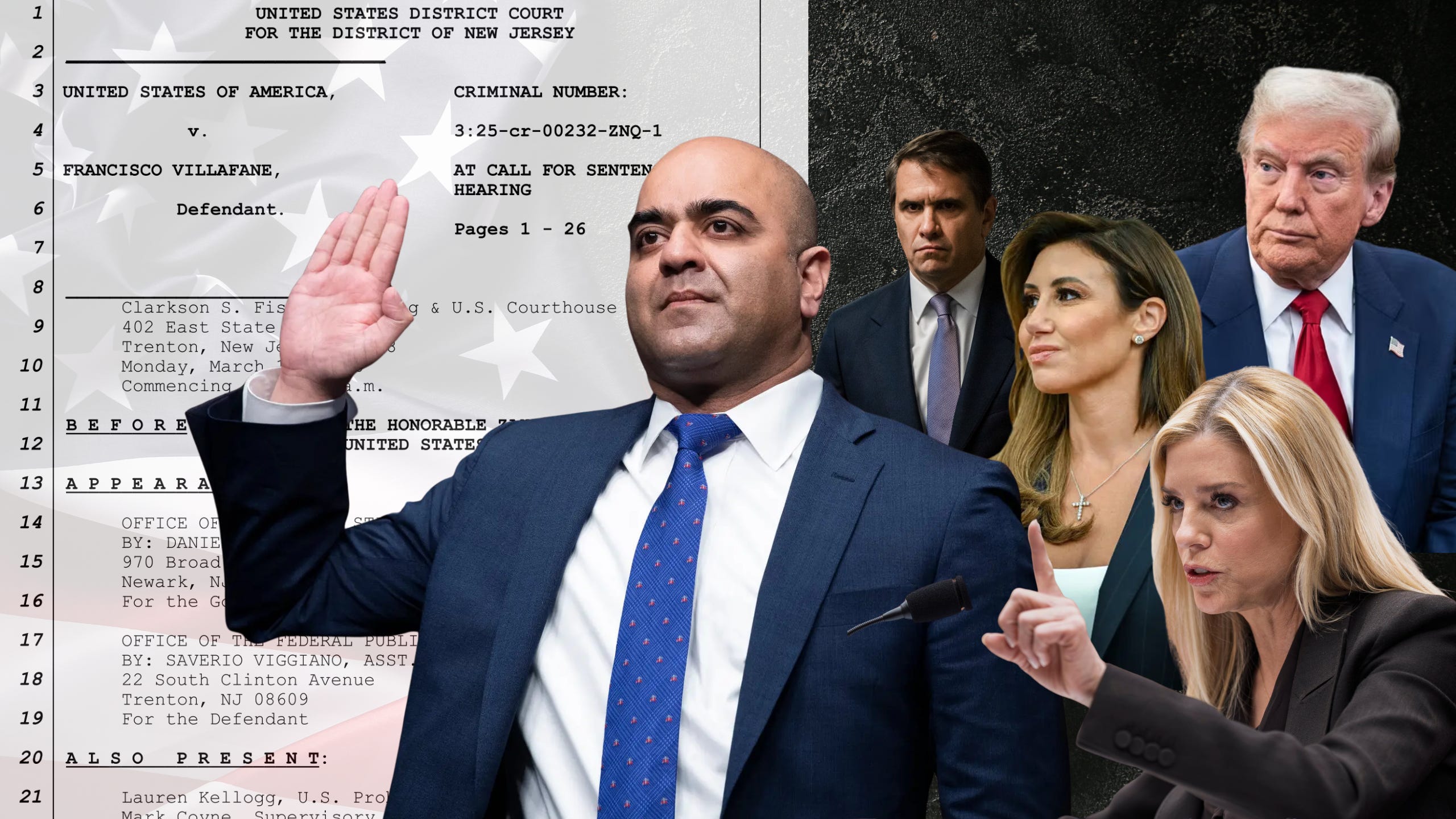
New Jersey District Court Judge Zahid Quraishi said something from the bench on Monday that DOJ alumni have been warning about for a year.
Pushed to the breaking point by DOJ’s repeated flouting of orders from the entire district court, Quraishi blasted the entire office: “Generations of assistant U.S. attorneys have built the goodwill of that office for your generation to destroy it in a year.”
Quraishi spoke with the controlled fury of someone who had served in that office himself and understood the value of what the Bondi DOJ has gutted.
It was only the tagline of a scorching broadside. All in all, it was the sternest and most incensed takedown of the DOJ as an institution that I have ever heard.
This isn’t a story about just one rocky hearing.
The District of New Jersey has been in institutional chaos since the beginning of Trump 2.0. First, Trump installed Alina Habba, his personal attorney with no meaningful prosecutorial experience, as the top federal prosecutor in the state. But the selection violated Congress’s carefully constructed legal regime for United States Attorney selections, which required, at that point, either a U.S. Attorney that the court appointed or a nominee that the Senate confirmed. Echoing rulings from several courts around the country, a federal court held that Habba’s appointment was unlawful.
And as it has done in the other analogous cases, the administration reacted with outrage, insisting that the president could install whomever he chose. Bondi’s DOJ proceeded to double down, this time installing what has been described as a “triumvirate,” three special attorneys dividing up the office’s portfolio among themselves.
Another federal judge, Judge Brann, last week looked at that arrangement and held that it too violated the framework that Congress instituted to protect its own constitutional advice and consent responsibilities. Brann stayed his own ruling pending appeal, but the legal verdict was unambiguous.
Through every one of these rounds, the judges of New Jersey have done a slow burn. They have warned, re-warned, and re-warned again. But rather than dismiss cases outright, the New Jersey courts have offered the administration off-ramps it has consistently refused to take. The administration’s answer, every time, has been to insist that the president has sole authority to appoint whomever he wants, to trash the judges publicly as activists, and to show up in court the next day as if nothing had happened.
That was the context of Monday’s hearing, which originally had been a sentencing in a child sexual exploitation case. The plea deal in the case was already troubling on its own terms: prosecutors had entered into an agreement providing for a third of the recommended guideline range without having reviewed all the evidence on the defendant’s device, and the evidence they had missed was particularly abhorrent. The judge fairly skewered the AUSA, asking how this screw-up happened. Was it your office, the FBI, or both? The AUSA’s answer—it was a combination of errors—did little to mollify him.
But the plea deal was the smallest part of what was going on. Quraishi had issued advance orders for specific answers as to who is actually running this office, and under what legal authority. He wanted to have the full account before deciding how to deal with the plea agreement. The not-so-subtle subtext was that if the leadership structure of the office continued to be unlawful, he might dismiss the case altogether.
The administration’s answer was to send the AUSA handling the case, accompanied by an additional lawyer, the chief of appeals, who had not formally entered an appearance. When that lawyer tried to speak, Quraishi cut him off and told him to sit down. When the lawyer tried again, Quraishi, incensed, ordered the Marshals to escort him from the courtroom, something, again, I have never seen nor heard of in my 40 years working for or closely following the Department.
After the ejection, Quraishi turned to the flummoxed AUSA, who was unable to provide the information the judge insisted on about office leadership. So the court declined to proceed with the plea hearing. Instead, he ordered the triumvirate itself to appear before him on May 4 to testify. He added that if they couldn’t provide satisfactory answers, he expected Bondi and Blanche in his courtroom.
He then closed with a devastating assessment: “You have lost the confidence and the trust of this court. You have lost the confidence and the trust of the New Jersey legal community, and you are losing the trust and confidence of the public.”
Not “you are losing.” You have lost. Courts have been warning for months that the Department was in the process of squandering its credibility and hard-won trust. Quraishi opined that after a year of squirreliness and insubordination, the Department has, in fact, crashed and burned—at least in New Jersey.
And Quraishi made clear the consequences of continued defiance. He warned that if the DOJ persists in installing an unlawful U.S. attorney, he will begin dismissing cases—the nuclear option that the New Jersey bench has been threatening for months but has so far declined to pull.
It’s important to understand the magnitude of what the DOJ has burned through. For generations, DOJ lawyers went into court drawing on a huge accumulated stockpile of institutional credibility. It was a sort of tailwind, built up over generations by prosecutors who worked by the book and earned the trust of courts, juries, and communities. Judges gave the government the benefit of the doubt. So did juries. All of this was earned slowly and painstakingly, over decades.
And while it’s the DOJ attorneys who now experience the chill of the lost confidence, the true cost falls on the public, in cases lost at the margin, or tossed out by impatient judges, or, most starkly in New Jersey, dismissed wholesale because an unlawful appointee oversaw them.
The lost credibility will not come back quickly. What Bondi, Bove, and company have burned through in twelve months took generations to build—brick by brick, case by case, court appearance by court appearance. Judges who have watched the government lie to their faces and trash them publicly will not extend the benefit of the doubt again overnight. Trust of that kind is restored, if at all, the same slow way it was built. That work now falls to a generation that didn’t break it.
While Quraishi’s condemnation was particularly loud and strident, it is no outlier: federal courts around the country have expressed similar sentiments. Nearly six months ago, the highly respected senior judge Paul Friedman, noting “instance after instance of departures from this tradition” of public officials acting “in obedience to [their] duty,” wrote, “[i]n just six months, the President of the United States may have forfeited the right to such a presumption of regularity.”
A recent update by Just Security documents no fewer than 90 cases in which courts have expressed their distrust of the Bondi DOJ. And those don’t even include the tidal wave of cases dealing with the DOJ’s relentless resistance to courts’ releasing habeas petitioners in immigration cases, which has generated an additional 35 or so similar denunciations.
Judge Quraishi is not done. Before the hearing closed, he ordered the triumvirate itself to appear before him on May 4 and testify about who is actually running the District of New Jersey and under what legal authority. If their answers are unsatisfactory, he made clear, he expects Bondi and Blanche in his courtroom next. He has also made no secret of his suspicion that Alina Habba still has her hand in the running of the office.
The AUSA was not simply clueless about Quraishi’s questions; he had been deliberately sent in that way. When Quraishi pressed him on who was running the office, he had no personal knowledge to offer, falling back on the position that “my answers today reflect the guidance that I’ve received from senior and supervisory AUSAs.”
The judge had ordered him to come prepared to answer exactly that question, and the administration’s response was to leave the one lawyer they sent to court in the dark. Quraishi understandably saw this as stonewalling. That’s precisely why he wants the supervisors themselves in his courtroom on May 4, under oath, with no buffer and no instructions to hide behind.
The DOJ will race to the Third Circuit for emergency relief, hoping to stay Brann’s order, which was the trigger for Quaraishi’s demands, before May 4. But absent a stay from a higher court, it will find itself staring down an approaching freight train. Indeed, Quraishi confronted the AUSA with Brann’s statement, ending his opinion that “a stay cannot validate an unlawful appointment. If the government chooses to leave the triumvirate in place, it does so at its own risk.”
Will the administration at long last comply with the law and give up on Trump’s insistence on installing unqualified, unconfirmable loyalists? Any Department of Justice that cared more about public safety and justice than politics and power would have done so long ago.
Which, with this DOJ, means it’s anybody’s guess.
Talk to you later.
death by a thousand “courts”
You can’t help but be proud of more and more of these judges and Judge Quraishi in particular.