

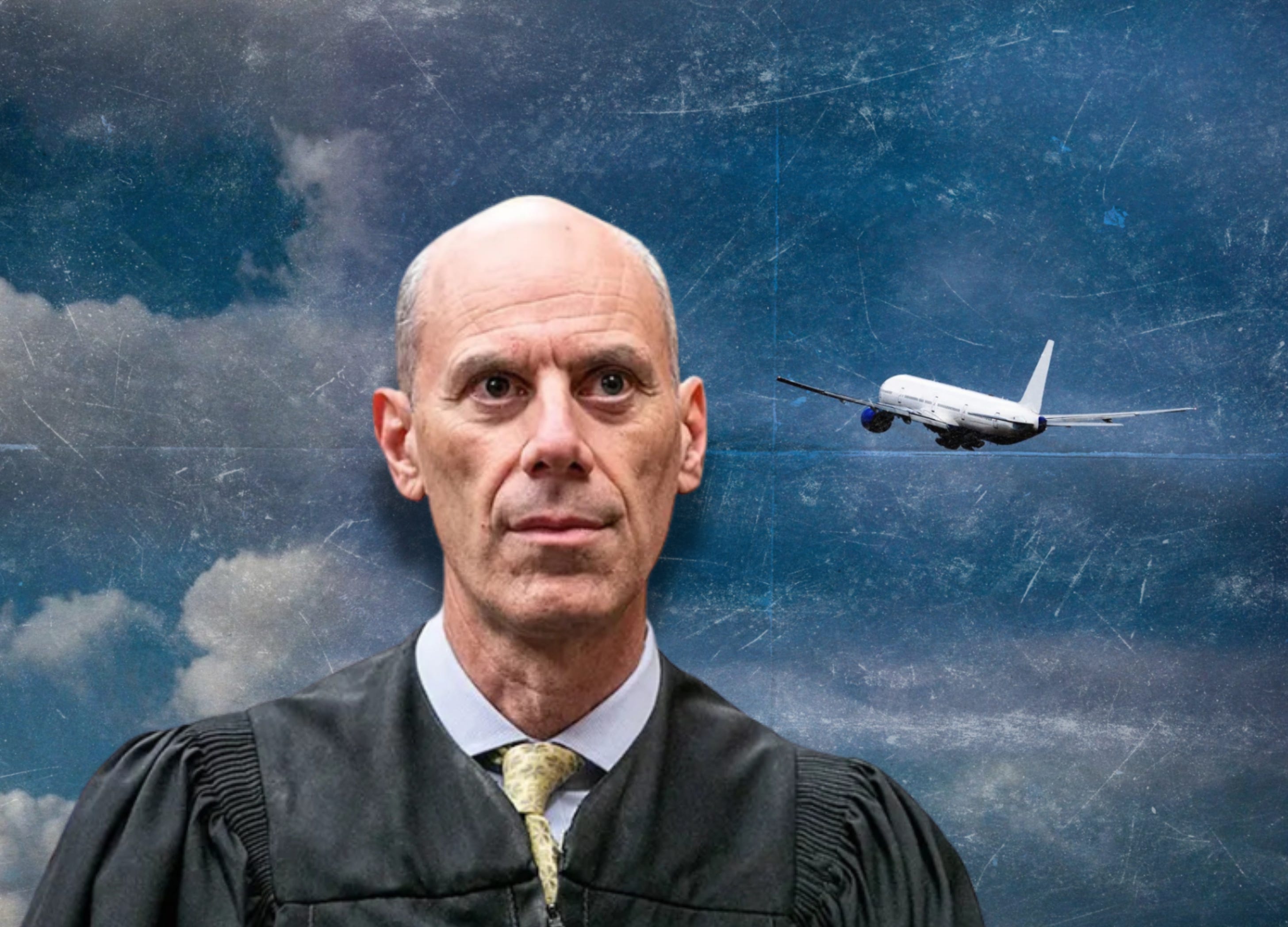
On Tuesday, the full D.C. Circuit will hear argument in a case that began on a Saturday evening in March 2025, when a federal judge ordered two planeloads of Venezuelan men returned to the United States and the administration, hours later, handed them to a prison in El Salvador instead.
Eighteen months later, the only question before the court is narrow, and worth stating precisely, because the government has spent great energy twisting it into something else: may Chief Judge James Boasberg continue to inquire into whether the administration knowingly defied his order?
The case has taken a long, tortuous path to Tuesday’s hearing. It is important in itself, but the stakes reach past it, to whether this administration set out to buck the law from the first days of Trump 2.0. That’s why I left my usual seat in the journalist’s box and signed onto an amicus brief in the case, one of twelve former Justice Department officials, Republicans and Democrats alike, who think Boasberg should be allowed to do his job.
Cast your mind back to March 2025. It was the first real collision between the second Trump administration and the federal courts: before the birthright-citizenship fights, before the funding freezes, before the parade of emergency stays that is now the background hum of this presidency.
At an emergency hearing on March 15, Boasberg ordered the government not to remove anyone under the Alien Enemies Act and, if planes were aloft, to turn them around. His statement from the bench: any plane carrying these people “needs to be returned to the United States.”
Notwithstanding Boasberg’s instructions, the planes landed in El Salvador and went straight into a maximum-security prison, and that country’s president, Nayib Bukele, posted a laughing emoji and the word “Oopsie. Too late.”
Later, a whistleblower—Erez Reuveni, a career Justice Department lawyer since fired—told Congress that at a March 14 leadership meeting, then-senior DOJ official Emil Bove said the planes were leaving “no matter what,” and that the Department might have to say “Fuck You” to the courts. Bove, since rewarded with a lifetime seat on the Third Circuit, told the Senate he couldn’t recall the profane remark.
Boasberg has doggedly insisted on getting to the bottom of what happened for well over a year. That has entailed plowing past a series of avoidance maneuvers from the Trump administration. The extended bob-and-weave has included refusing his questions on national-security grounds, insisting only the written order bound the administration, dismissing the matter as a “picayune dispute,” floating and then not invoking the state secrets privilege, serving up a declaration so empty he called it “woefully insufficient,” and filing a misconduct complaint against the judge himself.
When Boasberg continued to hang fire, the administration tried its well-worn play of crying “emergency” to the D.C. Circuit. A panel of three judges gave it a ringing victory that lasted only a little while before the court as a whole took the unusual step of vacating the opinion and agreeing to hear the case again. That hearing before the “en banc” court—that is, the full eleven judges on the D.C. Circuit—takes place Tuesday.
The now-vacated panel opinion was remarkably obtuse and spiteful. It’s the most nakedly pandering I have seen this side of Aileen Cannon by a judge—Neomi Rao—widely considered to be in the running for the next Supreme Court vacancy.
The proof of Rao’s overreach was the series of nasty swipes at Boasberg, a judge widely respected on both sides of the aisle. Courts of appeals taking a case away from a district court customarily cushion the blow with polite asides about the learned district judge. Rao savaged Boasberg, with words that likely shocked her colleagues but delighted her Oval Office patron. Among many potshots and low blows, she accused Boasberg of a “widening gyre” of investigation and wrote “criminal liability cannot turn on the unstated intentions (or post hoc assertions) of a district court judge.” It was her vitriol as much as her reasoning that I think explains the full court’s rare decision to vacate her opinion and rehear it en banc.
The eventual opinion will certainly excise those Rao nasty-grams. But the focus Tuesday will be on Rao’s legal analysis. The brief I joined made the fundamental point that, contrary to Rao’s suggestion, there has been no finding of contempt, and all Boasberg’s order does is consider the possibility based on compelling evidence pointing in that direction.

Second and relatedly, Rao’s opinion recasts that factual question as a legal one that isn’t in front of Boasberg at all. Criminal contempt, the majority reasoned, requires a “clear and specific” order, and Boasberg’s written temporary restraining order “did not clearly and specifically bar the government from transferring plaintiffs into Salvadoran custody.”
The analysis depends on the gap between what Boasberg said and what he wrote a half-hour later, enjoining “removing” class members without repeating the turn-around command. But oral orders from the bench bind the parties who hear them, and Bove himself, in a sworn declaration, has acknowledged that he knew of Boasberg’s verbal order and advised Homeland Security Secretary Kristi Noem on “the transfer of custody” anyway.
As our brief argued, no reasonable Justice Department lawyer would treat a clear oral command as optional while waiting for the written version to catch up. At a minimum, whether the lawyers understood it that way is a question of fact on which contempt could turn—the very kind of issue Boasberg is entitled to run down.
As Judge Michelle Childs warned in dissent, the majority’s logic would “echo in future proceedings against all litigants,” letting anyone “argue, based on their preferred interpretation of a court’s order, that they did not commit contempt before contempt findings are even made.”
Two further arguments will get an airing on Tuesday. The first is that judges don’t investigate crimes; prosecutors do. The position leans on a 1987 Supreme Court case, Young v. Vuitton, holding that once a criminal-contempt prosecution is underway, an independent prosecutor, not the court, decides how to investigate and whom to call. The argument, however, is a non-sequitur. Young governs the prosecution; it says nothing about the threshold decision every court must make first: whether the matter is even worth referring to a prosecutor at all. A judge cannot make that call in a vacuum, and gathering enough facts to make it is not the same as running the prosecution.
The government’s last argument is its weakest: that the order was void from the start, because the Supreme Court later found the district court lacked jurisdiction, so defying it couldn’t be contempt. First of all, that’s not quite right; as Judge Childs pointed out, the Court did not determine that there was no jurisdiction in the federal courts; rather it held that the case should be brought as a habeas corpus lawsuit. But even on its own terms the argument fails, because a court has authority to enforce its own commands while it sorts out whether it has jurisdiction. Otherwise every litigant could ignore any order on a bet about how the appeal comes out.
The D.C. Circuit should stand behind Boasberg’s doggedness. It would have been easy for him to drop it, but I think as Chief he sees himself as acting on behalf of his colleagues, whose three-year project of trying the January 6 offenders—the largest prosecution effort in the Department’s history—was wiped away with a stroke in Trump’s wholesale pardons the morning that he took office.
Moreover, Boasberg is now, in a sense, carrying the load for American society and history. The administration has been intent, from its first minutes in office, on the Orwellian project of whitewashing history and erasing Trump’s perfidy, the worst by any president in our history. Its war on the truth is comprehensive: from the burial of the Jack Smith report, to the campaign to launder the Smithsonian’s account of the American past, to the ouster of the National Archivist charged with keeping the government’s own record. As Orwell wrote of the machinery of the Party, “Every record has been destroyed or falsified... And the process is continuing day by day and minute by minute. History has stopped.”
The D.C. Circuit argument tomorrow thus has a dual role: it will settle Boasberg’s ability to continue to hold the administration accountable. But it also will serve as a sort of truth and reconciliation commission, of the sort served by the January 6 committee during Trump 1.0. It is vital for us to know as a country whether the administration came into office determined to elevate presidential will over the rule of law; to land the planes “no matter what.” Unless Boasberg is permitted to finish the job he started well over a year ago, we may never learn the answer.
Talk to you later.
The DOJ, speaking for and with trump's overt encouragement, is saying "I am the law", and this is the crux of the matter. The lower courts have almost been unanimous in scuppering that posture, but there has been enough succor supplied by the Scotus majority's use of the "shadow docket" to stay several of those important lower-court decisions to further embolden the DOJ scofflaws to keep pushing trump's patently unconstitutional executive orders.
Good on Judge Boasberg for persevering, a no little cost to a well-earned reputation as a just and well-versed district judge.
You said it, Harry…presidential will over rule of law. Scary stuff.