

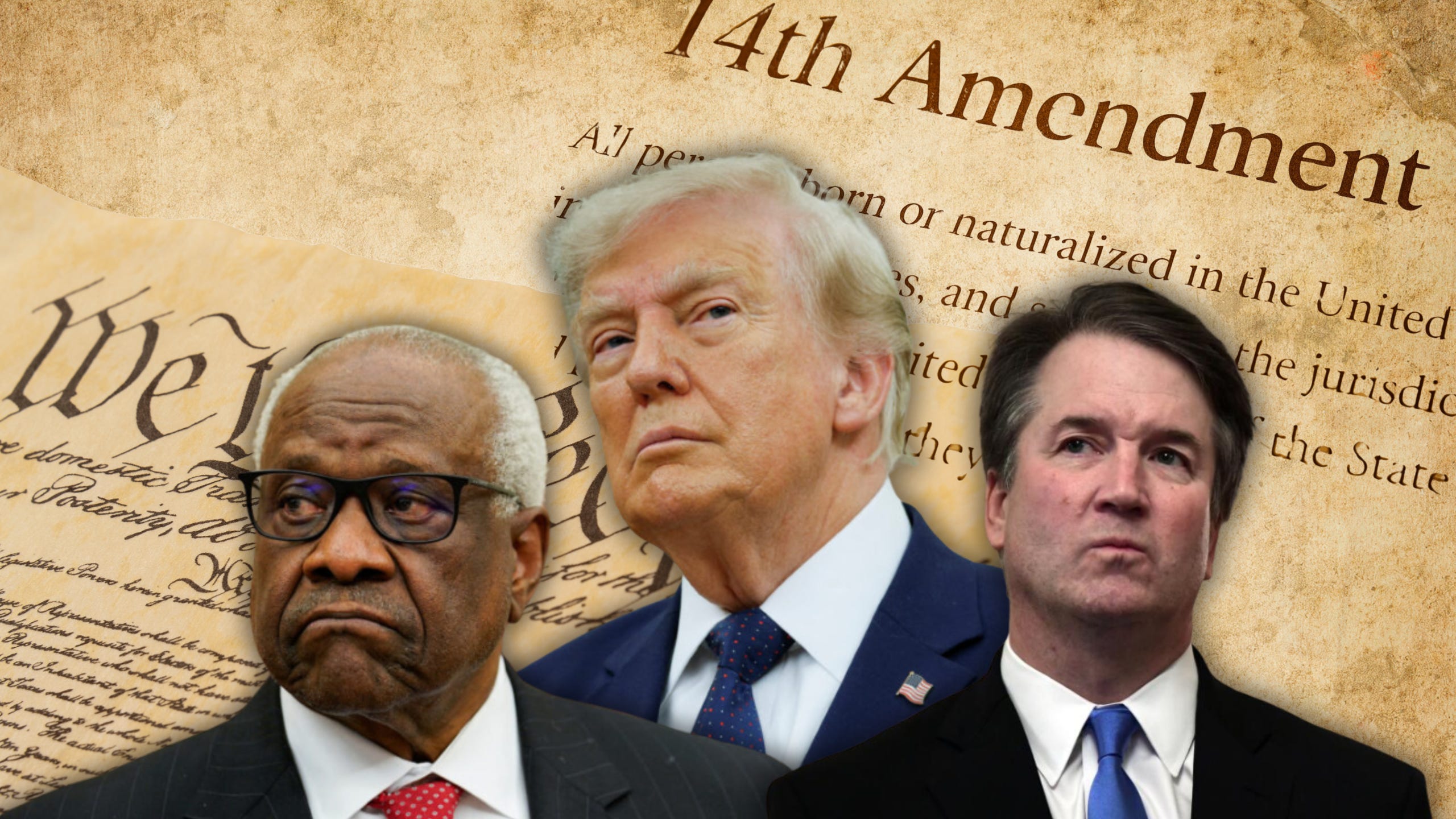
While the media’s primary reaction to the Supreme Court’s opinion in the birthright citizenship case was to tout the Court’s rebuff of Trump, many commentators, myself included, perceived a different headline. The real, gobsmacking detail was not the Court’s holding but the fact that 4 Justices—Thomas, Gorsuch, Alito, and Kavanaugh—were prepared to uphold a radically counter-textual reading of the plain text of the 14th Amendment to exclude from citizenship children born here to parents who were in the country illegally or only temporarily.
Justice Thomas’s principal dissent in Trump v. Barbara—joined by Justice Gorsuch—rests on a discredited method: original-intent originalism, the practice of asking what a text’s drafters subjectively meant to accomplish rather than what the words they wrote actually say. Justice Kavanaugh’s separate opinion raises a different, and in some ways more troubling, set of problems of its own.
Thomas’s dissent is far more tendentious and unorthodox than just the offensive bottom line. Thomas didn’t simply reach a result aligned with the administration’s wishes; he got there by abandoning the method of interpreting the Constitution that mainstream judges and scholars, conservative and liberal alike, have firmly adopted.
The first sentence of the 14th Amendment prescribes a clean two-part test: anyone 1) “born... in the United States” and 2) “subject to the jurisdiction thereof” is a citizen. Period, full stop.
It’s not difficult to apply the first part: Trump’s flights of fancy aside, it’s clear what it means to be born here. So any play in the joints has to be in the interpretation of “subject to the jurisdiction thereof.”
The 5-person majority opinion written by Chief Justice Roberts applied the conventional and commonsensical meaning of that phrase. The opinion holds that the clause “uses jurisdiction in its ordinary sense—referring to the power of the United States to govern those within its territory.” You are subject to the jurisdiction of the United States if you are bound by the web of obligations and privileges that apply to us all.
As Chief Justice Roberts wrote in the opinion of the court, “citizenship, then and now, was the right to have rights—to freely participate in our political community…The framers of the 14th Amendment extended that promise to ‘every freeborn person in this land.’”
That’s the same way the Court’s 1898 opinion in Wong Kim Ark, which figured heavily in the oral argument and the opinion in Barbara, construed the phrase.
The Wong Kim Ark case was a habeas corpus action brought by a man born in San Francisco to Chinese parents whom the United States tried to keep from reentering the country after a trip to China. The Supreme Court held that the 14th Amendment’s first clause confers U.S. citizenship on virtually everyone born on U.S. soil and subject to its jurisdiction, including children of noncitizen parents (with narrow exceptions such as children of diplomats). The opinion is the origin of the firmly established constitutional principle of birthright citizenship that Trump is trying to defeat.
Thomas’s contrary position is that the “subject to the jurisdiction” clause incorporates, for elaborate historical reasons, a notion of domicile: that the child’s parents were not merely in the country, but had set down roots and developed a sense of loyalty to the nation.
The obvious challenge, which I think they don’t come close to surmounting, is how to wrest that reading from the simple words of the first clause of the 14th Amendment.
Thomas’s opinion begins not with the words of the text but with a history of Dred Scott, Frederick Douglass, and 14th Amendment drafter John Bingham. He builds methodically toward the claim that the amendment was, in his words, “designed and understood to secure equal rights for the freed blacks.” This theme continues throughout the ninety-some pages of his dissenting opinion, which argues that the 14th Amendment’s framers had a narrow purpose in mind: to undo the Dred Scott abomination and secure citizenship for the children of the freed slaves.
Thomas builds his idiosyncratic view brick by brick, out of individual senators’ floor speeches from 1866, each treated as though it explains the meaning of the ratified text. So, Thomas quotes Senator Trumbull’s own gloss on “subject to the jurisdiction”: “Not owing allegiance to anybody else. That is what it means.” He quotes Senator Howard insisting the word “jurisdiction” “ought to be construed so as to imply a full and complete jurisdiction”—not, as the majority and Wong Kim Ark both hold, the ordinary territorial jurisdiction any sovereign exercises over anyone physically present within its borders.
In place of textual analysis, Thomas offers a stack of individual lawmakers’ asides about what they personally meant by a phrase. The majority trashes the approach on its own terms. “The trouble,” Roberts writes, “is that there is scant evidence for this dramatically revisionist view.”
But there’s a yet bigger flaw with Thomas’s opinion. Interpreting constitutional text based on the intent of the drafters, what was subjectively in their heads, has a name: intent originalism. It also has a provenance: it was once a mainstream method of constitutional interpretation, but it has since been firmly rejected, especially by conservatives. No less an avatar of conservative thought than Justice Scalia disavowed it, insisting that the inquiry was never the search for “the intent of the Framers” but for the original meaning of the text. He put it bluntly: “It is the law that governs, not the intent of the lawgiver.”
At first glance, the distinction may seem arcane and academic. It’s not: it’s a fundamental principle of legislative legitimacy. If a drafter privately had something narrower, or stranger, in mind than the words she voted to put before the public, there is no cogent reason why that private mental state should bind the rest of us. That is why “intent originalism” has been more or less universally superseded by “meaning originalism,” which focuses (simplifying somewhat) on the public meaning of the text’s words.
Thomas’s method runs the opposite direction: instead of probing the (straightforward) meaning of the actual text, he asks what its drafters were trying to achieve, and then reads the words no more broadly than that goal required.
The classic demonstration of why original-intent originalism collapses is the canonical case of Brown v. Board of Education. Many members of the Reconstruction Congress neither anticipated nor intended that the 14th Amendment would outlaw segregated schools: many of its own drafters ran segregated schools in Washington, D.C. If the framers’ intent governs, Brown looks to have been wrongly decided, a result that literally no jurist, and extremely few academics, would countenance.
In fairness, that consensus may have been overstated. Judge Michael McConnell and others have shown the framers’ views on school segregation weren’t as monolithic as assumed. But that revision only reinforces the deeper point: relying on what was privately in legislators’ minds, rather than the words they enacted, is an unstable method that can flip an outcome depending on which stray comment you excavate. That’s why original-intent originalism is not merely flawed but effectively moribund.
The reading of the Barbara majority of the “subject to the jurisdiction” language was no different from how the Court’s 1898 opinion in Wong Kim Ark read the phrase: an alien present in the country, Justice Gray wrote, ‘is completely subject to the political jurisdiction of the country in which he resides’—owing obedience to its laws and answerable to them, just as a native-born citizen would be.
The Court identified a narrow set of exceptions in which persons born here, e.g., the children of foreign diplomats, would not be subject to our laws in the normal sense. Domicile appears in the opinion only as a description of the parties actually before the Court; nowhere does Gray treat it as a legal requirement of jurisdiction itself.
As Roberts summarized the case, “[w]hat the Court held in Wong Kim Ark was simple: the Citizenship Clause incorporated the common law and granted citizenship to nearly all children born in the United States.”
There’s much more detail to Thomas’s argument, but it’s in service of the same private-meaning project, notwithstanding his own claim, at one point, that he’s simply applying original meaning. He spends many pages arguing that “subject to the jurisdiction” secretly encoded the 19th-century legal concept of domicile—a person’s fixed, permanent home—and, additionally, that domicile implied something more freighted: exclusive, undivided allegiance to the United States.
That’s shaky on its own terms; domicile has never required renouncing competing loyalties, only living somewhere with intent to stay. The majority trounces Thomas’s historical analysis: “As to the principal dissent, it is simply not true that domicile in a new nation severs one’s ties to the old one.”
But the more glaring obstacle is simpler and insuperable: the 14th Amendment doesn’t say “domicile.” It says “subject to the jurisdiction thereof”; and, as the majority holds, those words refer, in 1868, or 1898, or 2026, to the “power of the United States to govern those within its territory.”
Justice Jackson, in a concurring opinion, takes issue with Thomas’s crimped reading. She asserts that it “elides the entire point of the Second Founding: The Reconstruction Amendments were an anticaste, antisubordination reset for the Nation, not a mere spot treatment for the dark stain of slavery. And the expansive, grand language of the Amendments, including the phrase that the Court correctly construed in the Barbara case, reinforce her view and undermine Thomas’s.
The defect with Thomas’s principal dissent is more than just the fairly odious and un-American result it reaches. It’s the method he employs to reach it. Thomas asks what the framers intended to accomplish, instead of the meaning of what they actually wrote—a method nearly every serious originalist, including the conservative justices who built modern originalism, has definitively rejected. That choice of method is itself proof of how far he had to strain to make a flagrantly anti-textual position sound tenable.
Justice Kavanaugh’s separate concurring opinion is, in a way, even more muddled and strained. Kavanaugh first concludes that a 1940s statute, 8 U.S.C. §1401(a), repeating the 14th Amendment’s exact words, already forbids Trump’s order. That’s a solid conclusion: under well-established interpretive principle, Congress is presumed to have adopted the judicial construction already given to language it reenacts, here Wong Kim Ark's reading. On that narrow, statutory ground alone, the executive order is unlawful, and Kavanaugh says the Court should have stopped there rather than reach the constitutional question at all.
Then, departing from his own advice, Kavanaugh undertakes a whole separate constitutional analysis. He opines that Wong Kim Ark is flawed because the exceptions, such as children of diplomats, that it recites to the general “subject to the jurisdiction” proviso were never meant to be a closed, exclusive list.
He offers no particular support in the Wong Kim Ark opinion—which directly contradicts the now law-of-the-land as represented by the majority opinion—not to mention text or history, for this conclusion. He just says that the case’s treatment of the exceptions as a closed set is “incorrect, in my view.” His contention is that other exceptions that are “relevantly similar” to the ones in Wong Kim Ark should also not be covered by the general guarantee.
Fair enough. In fact, along with Mark Greenberg, I have written a law review article making this very point. In “The Meaning of Original Meaning,” Greenberg and I pointed out that advances in knowledge or morality can change the set of circumstances to which a provision applies. That’s essentially what happened in Brown v Board of Education, in which the court and society came to understand that “separate but equal” was untenable, whatever the framers of the amendment might have supposed. Segregated schools unavoidably denied minority races the equal protection of the laws guaranteed in the 14th Amendment.
But needless to say, it doesn’t follow that anything goes, and Kavanaugh goes well outside the lines in trying to argue that the language of the 14th Amendment can properly be understood to exclude from its protection the children of illegal aliens or persons here temporarily. Kavanaugh’s musings about the factual commonalities in the Wong Kim Ark exceptions have nothing to do with what matters, which is the language of the 14th Amendment.
Kavanaugh writes that such children are “relevantly similar” to the groups of persons excluded in Wong Kim Ark. But this is where he dives headlong into the same rabbit hole as Justice Thomas occupies. He jerry-rigs what he calls “the only apparent principle unifying the four disparate exceptions,” which he says reduces to the parental status of the children. That’s just constitutional wishful thinking. The Court already has rejected this rewrite of Wong Kim Ark, explaining how the case set a governing principle, which the Barbara opinion strongly reaffirms. Kavanaugh is inviting Congress, or really Trump, to venture down a dead end that the majority already has boarded up.
Relatedly, Kavanaugh never even attempts to explain why the children targeted by Trump’s order would somehow fall outside “[t]he power of the United States to govern those within its territory.” He doesn’t rebut the majority’s holding that they are; he simply declines to treat that holding as settling anything.
That’s an exceedingly strange place to land: a majority of the Court has just held, as a constitutional matter, that these children are subject to U.S. jurisdiction, and Kavanaugh’s response isn’t to explain why that’s wrong, but to suggest Congress could reach a different result anyway, without ever saying what, textually or historically, would make that result correct. Thomas at least offers a reason for his conclusion, however discredited the reasoning is.
Kavanaugh’s separate opinion may be ungrounded speculation, but its practical effect is far from academic. It permitted Trump to seize a partial victory from what should have been a certain defeat: Trump immediately fastened on Kavanaugh’s suggestion, insisting Congress could still legislate his own, xenophobic definition of citizenship, notwithstanding that it plainly would run afoul of the majority in Barbara. The separate opinion is going nowhere legally, but it permits Trump to try to fan the flames of an issue that should be dead and buried. Explaining that choice may call for a discipline other than law.
Talk to you later.
Harry sat down with California Senator Adam Schiff for his latest installment of Talking San Diego. You can watch their full conversation here.
Intent originalism fails because the final words written into law are almost always a compromise. Sure, some of the people behind writing it really wanted it to mean other things, and they sure as shit complained about that both vocally and in written texts.
But what they wanted is NOT what got written down, because other people wanted other things, and the words they ultimately chose were meant to reflect that reconciliation.
thomas is a stain on the judiciary.... must be tough to be an african american and being represented by such a corrupt ..... insert your own word....