

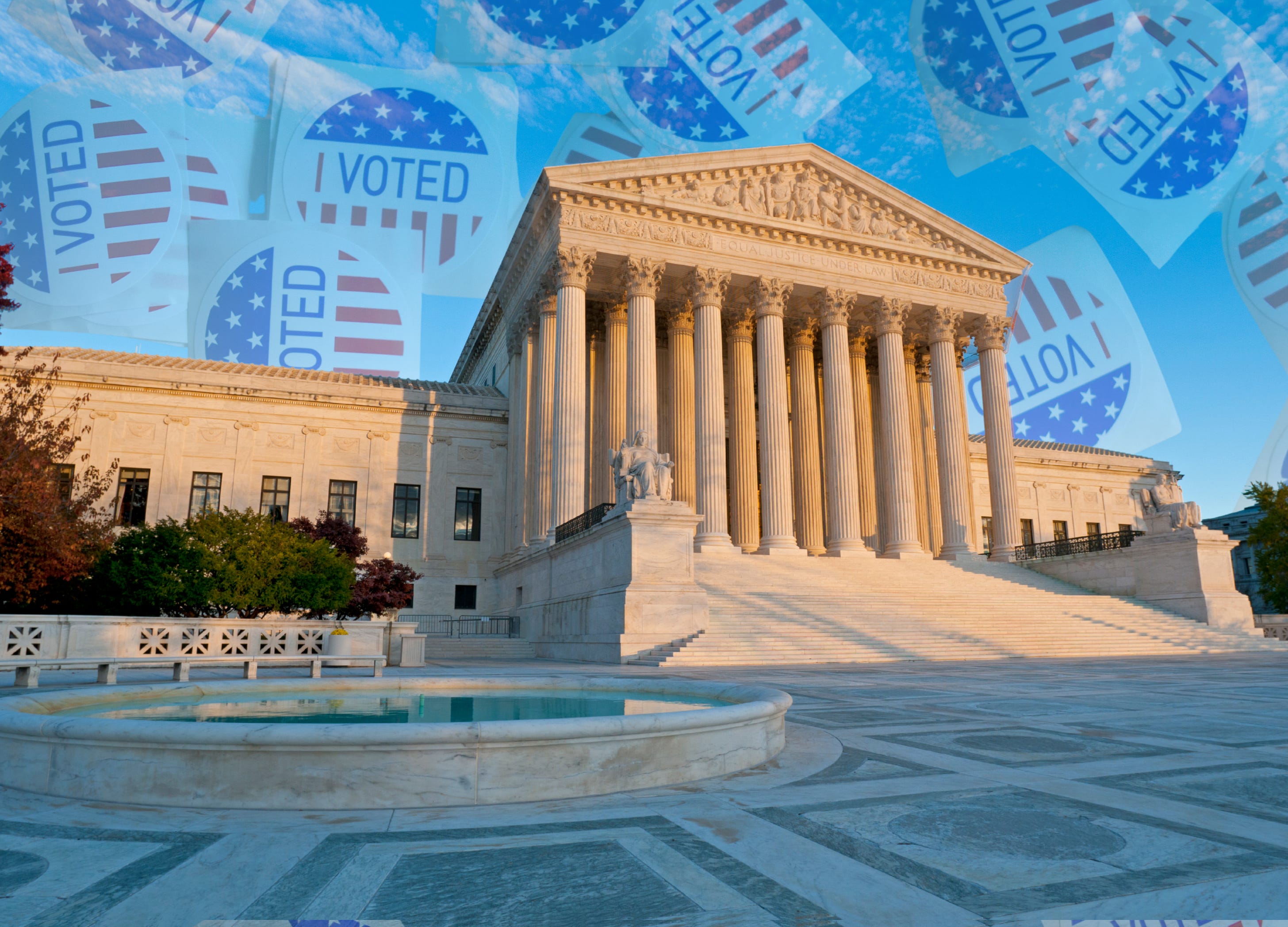
Having seen the Supreme Court issue a series of pro-administration rulings in emergency motion cases, we were holding our collective breath awaiting the decision in the USPS mail-in order case. We can now exhale. Monday night, the Court denied the Trump administration’s effort to reinstate its order on USPS regulation of mail-in voting.
The upshot is that mail-in voting, already underway in several states, will proceed normally for the 2026 midterms, although it’s entirely possible that there will be vestigial chaos from the fire drill the administration put the states through as it stood up the rule.
I’d thought, not without hesitation, that this is how the Court would rule. The Court’s unanimous ruling last Thursday in the Missouri redistricting case suggested the justices were paying attention to the practical impact of a change in the election rules or procedures so close to the midterms. But in some respects Monday’s order came out better than I expected. Besides shutting down the administration’s effort to upend the system in the midterms, the decision makes it materially harder for the administration to run the same play in 2028.
I see five important takeaways from the opinion.
1. A ruling on the merits.
The Postal Service rule required states to redesign their ballot envelopes, add a barcode unique to each voter, and upload the name, address, and barcodes of every mail voter to a new federal portal before sending out a single ballot. Thereafter, USPS would screen each envelope and refuse to deliver any that didn’t match. As many analysts had demonstrated, it was a recipe for the disenfranchisement of untold numbers of voters, almost certainly disproportionately Democrats.
Judge Talwani in Boston enjoined it, twice, and just yesterday morning, Judge Carl Nichols, a Trump appointee, issued an even broader preliminary injunction. They stayed the first one on the dubious ground that it wasn’t ripe. It was Talwani’s second injunction that the Supreme Court took up and declined to stay Monday.
The Court can be maddeningly delphic in its disposition of emergency petitions, including at times just announcing the result with no further explanation. The unsigned order in this case was bare bones, but the bones were strong.
The Court first announced that the government is “unlikely to succeed on the merits of its challenge” to the injunction. Those nine words are the most important in the opinion. They mean that a majority of the Court thinks that the administration’s defense of the rule is a loser. And the reasons, though unexpressed, are almost certainly the same as Judge Talwani, Judge Nichols, and others have already spelled out: the power to run elections lies with the states, and to a degree with Congress, but not with the executive acting through the mail carrier.
The inclusion of the majority’s sense of the merits is all the more noteworthy because it was unnecessary. In the following sentence, the Court announced, “And the equitable factors applicable for obtaining emergency relief from this court do not favor a stay.”
Those factors are likelihood of success on the merits, irreparable harm to the applicant, the balance of harms to the other parties, and the public interest. The first two do the heaviest lifting, but a decisive imbalance on the others can independently sink an application.
So it was both purposeful and very significant that a majority of the Court specified its disagreement with the administration’s position on the merits, in addition to the sufficient grounds of the failure to satisfy the other factors. That casts a deep shadow over the administration’s certain effort to revive the rule after the midterms.
One caution on the vote count. We know at least five justices believe the government is likely to lose, because that sentence had to command a majority. We know Kavanaugh is not one of them, because his concurrence says the opposite (more on that below). And we know Alito and Thomas dissented. That gets you to either 6–3 or 7–2—but the presumed “7–2” you’ve seen might be an overread. Gorsuch is simply unaccounted for. He makes no appearance in an unsigned order, and on this record we can’t assume where he landed.
2. The government had no answer to the bedlam argument.
My sanguinity about the case was not a prediction on the merits. Rather, in my view there was an overwhelming case that the rule would inflict far more burden on the challengers than on the administration; that point is captured by the factor of “the balance of equities,” which is part of the standard analysis for a stay.
The Court had received an amicus brief from many of the most prominent election-law professors in the country setting out a forceful argument that the chaos the rule would inflict on states and voters so overwhelmingly outweighed any harm to the government that the Court could simply rely on that imbalance and go no further.
The evidence below was voluminous and uncontested: applying the rule now would disenfranchise voters, force some officials to violate state law, and impose enormous costs on thousands of election offices at the worst possible moment. It also entailed a concrete risk, built into the working of the rule, that entire batches of ballots would be rejected over a single mis-scanned barcode. That is a scenario no court wants to endorse, much less be seen as creating.
The administration’s response to the prospect barely rose to threadbare. The Solicitor General dwelt on the government’s own supposed injury—really just its inability to execute its policy—and offered no corresponding account of the harms to voters and states, reducing them, in a single word, to “alleged.”
We were too close to the election, and the case too far down the line, for the government to finesse the matter by simply ignoring the horribles that largely drove the district court’s decision. Of course, there wasn’t much it could say. The case was overwhelming that putting the rule into effect would drop a nuclear bomb in the middle of the election.
3. Alito and Thomas have become a lunatic fringe.
Only Alito, joined by Thomas, dissented. Alito’s opinion is in many respects hyper-technical. He never asserts four-square that the administration has authority to enter the mail-in order. Instead, he offers a series of cavils: that the organizational plaintiffs lack standing, and that the states are left with an ultra vires (legal speak for something outside of legal authority) “Hail Mary pass” that “rarely succeeds.”
But it’s the two justices’ treatment of the balance of equities that reads like a dispatch from another planet. In a case where the harm ran overwhelmingly one direction, Alito somehow finds the equities favor the government. He takes the chaos of last-minute implementation “very seriously,” then discounts it as contested: twelve states, he notes, backed the rule and called compliance practicable; unsurprisingly, they were all republican and thus stood to benefit from the rule.
Alito finally pivots to blame, faulting the plaintiff states and the courts for the rule’s late timing. His blame analysis is both irrelevant and misapplied. The equities ask who gets hurt if the rule takes effect now, not who is responsible for the calendar; voters facing disenfranchisement in November are no less harmed because, in Alito’s telling, the wrong people caused the crunch. And the delay he laments was in no small part the Court’s own, as he concedes when he faults his colleagues for spending a month drafting opinions in the first round.
4. The prospect for the rule’s return.
It’s a foregone conclusion that the administration will take another run at the rule. They may try to make adjustments at the margins to address the court’s objections, though that seems scarcely possible; or they may just rely on a longer runway that would blunt any argument of chaos.
One question this will implicate is the best reading of Justice Kavanaugh’s concurrence. Kavanaugh wrote separately to say that, in his view, there’s “at least a fair prospect” the rule falls within the Postal Service’s authority, but that applying it this close to the election would be arbitrary and capricious under the Administrative Procedure Act, because officials lack time to implement it. That rationale would fall away if the order were reissued methodically and with plenty of time to implement it.
But unlike so many cases in which an anti-administration result must run through Kavanaugh, a majority of the court has said that the administration’s case on the merits is likely doomed.
There’s an important doctrinal point that enters into the analysis, assuming, as most people predict, that the Democrats win back control of the House in the midterms. A Democratic-controlled Congress could defund the Postal Service’s ability to enforce the rule; but it wouldn’t have to do that to make the administration’s path far steeper.
First, under Democratic control, the House itself could be an impeccable plaintiff, bypassing all of Alito’s standing suspicions. Even more importantly, Congress could simply register its objection to the rule. That would put the administration on the “lowest ebb” of authority, according to the influential Robert Jackson concurrence in Youngstown Sheet & Tube Co. v. Sawyer (1952)—the steel seizure case. That footing nearly invariably leads to invalidation of executive action.
5. The bottom line—a really important decision, if only for what it avoided.
The headline to start and end with: it’s a very good decision in a very important area at a very opportune time. Viewed from the vantage point of what could have happened, this was one of the most consequential election cases to reach the Court in years. The stakes were enormous, and the Court showed itself willing to assert itself against the administration on the specific terrain of elections. That’s a very welcome contrast from the run of election cases, such as Callais (finishing the execution of the Voting Rights Act), in which the Court issued dubious rulings in favor of the administration.
In the immediate aftermath of the decision, I had the pleasure, and Fed Heads had the benefit, of a Substack live with Georgetown Professor Steve Vladeck, who brings deep background knowledge and razor-sharp insight to discussions about the Court. Steve had occasion to invoke the line from “The Princess Bride,” that the rule, for 2026, is “mostly dead.” It follows, however, that it may be slightly alive; and the administration will spend the next two years trying to find the part that still has a pulse.
Talk to you later.
Today is National Voter Registration Day. Register to vote or check your registration status here.
I just checked and 47 States allow early in person voting. Republicans will do everything they can to make voting difficult like, reduce polling places, so to every registered voter, VOTE EARLY IN PERSON.
You can tell by their attempts that the Republicans are in a panic because WE THE PEOPLE are mightily pissed about the damage done to our rights ghts and liberties by this regime.